
The Thing From Another World (1951) 75th Anniversary Review
Remember: Watch the skies, everywhere!

The Thing From Another World (1951)
Director: Christian Nyby
Screenwriters: Charles Lederer, Howard Hawks, Ben Hecht, John W. Campbell Jr (based on the novella by)
Starring: Margaret Sheridan, Kenneth Tobey, Robert Cornthwaite, Dewey Martin, Robert Nichols, James Arness
by Kieran Judge
Years before John Carpenter went on to make his iconic, influential, and revered take on the story by John W. Campbell Jr. in 1982, it was the team of producer Howard Hawks and director Christopher Nyby who took a stab at the classic story of the alien in the ice. With a loose premise taken from Campbell’s Who Goes There? novella, but with a number of important changes to its alien menace, a team of scientists near Anchorage, Alaska, investigate the site of a meteor crash, only to discover a spaceship and alien life form now buried in the ice. After taking the alien back to their base, it thaws out and goes on a rampage against the base in search of blood.
After the 1940s, and especially following in the wake of the Second World War, horror changed. No longer were the creeping castles and malevolent moors of Universal Studios’ 1930s chillers the sites of creepiness, which were made into endless sequels before being parodied in the monster rallies and Abbott And Costello movies of the 40s. The mechanised horror and atomic terror of the Second World War just a few years prior, shifted the focus of what was truly terrifying. It wasn’t some beast from a grave; now it was the realm of science. In post-war years, the Golden Age of Science Fiction is really kicking off. The first Foundation novel by Isaac Asimov, collecting the short stories published over the previous decade, was released in 1951, the year The Thing from Another World was released. Arthur C. Clarke published his first novel, Against the Fall of Night, in the same year, and Robert A. Heinlein started publishing his first novels in 1946. The true atomic terror monster, Godzilla, made his appearance in 1954. Them! was released in the same year, with a tale of mutated giant ants. The Body Snatchers would be published in 1955. It Came From Outer Space is in 1953, and War of the Worlds and Earth vs The Flying Saucers get unveiled in 1953 and 56 respectively. The Roswell incident occurred only in 1947. Science, and science-fiction, are the threats here.
It is therefore not surprising that Campbell’s 1938 story of a monstrous entity mimicking people known as normal and harmless by their peers for many years, when Hitler and Stalin and Mussolini are on the fascism scene, would see a slight change for an alien creature now consisting of vegetable matter, the realm of science gone wild. Animals, plants, the natural world, attack with a vengeance, with an insatiable thirst for blood which updates the old Slavic vampire legends for the modern age. We move to the North Pole, Alaska, close to the USSR borders, and much closer than Antarctica. We dress one of the misguided scientists, Dr Carrington (with a name very close to Carrion), up in a felt hat closer to Russian dress than the others. This is the context of the film, steeped in the global politics and generic changes of the age, at the cusp of the McCarthy trials in only a few years time, when the old imitation narratives that The Thing from Another World eschews from the novel would return in force in the Cold War sci-fi horror movies that this film is part of, but doesn’t lean as heavily into as others would in future years.
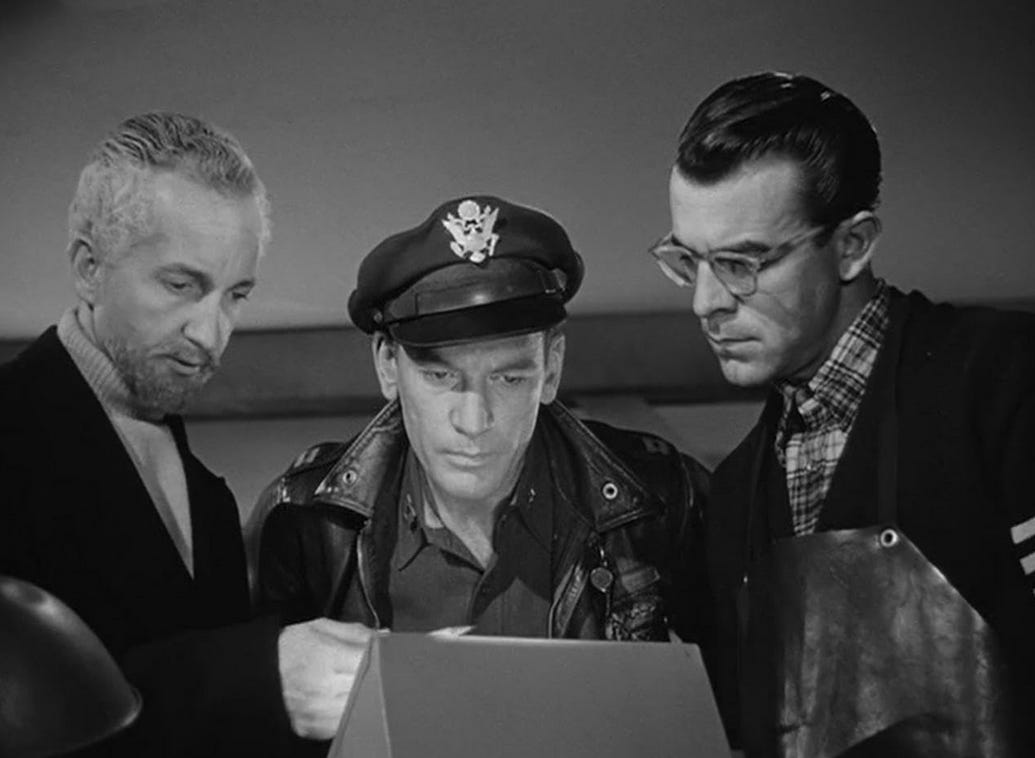
Thankfully you don’t have to know any of this context, because even without it, the film is 90 minutes of good, chilly, classic horror fun. Cleverly building up the tension, everything goes step by step, from rumours in the north, to Geiger counters playing up, to the slow reveal of the size of the ship. The monster itself, played by James Arness, is kept hidden from the viewer for over half the runtime, only appearing sporadically for maximum impact, a huge, Frankensteinian mountain of a man with the only intent to destroy with great paws, impervious to bullet fire. It is built up with description at first, in a similar vein to Hannibal Lecter’s reveal in The Silence of the Lambs (1991). Although the changing of the monster’s physiognomy downplays a lot of the paranoia elements that would be brought back into play in John Carpenter’s 1982 version (with a title sequence very much in homage to this film’s shining titles), there’s still moments of squabbling and arguing in a taut, uninviting environment which keep the viewer as tense as it can manage.
Most of the performances are good, with Robert Cornthwaite’s turn as the obsessive Dr Carrington eventually earning him a spot in the Science Fiction Hall of Fame in 1993. With archetypal mad-scientist lines such as ‘“There are no enemies in science, only phenomenon to study”’ and ‘“Knowledge is more important than life!”’, he prefigures Ian Holm’s android Ash from Ridley Scott’s Alien (1979) by nearly thirty years. Elements involving a Geiger counter slowly creeping up as the creature advances down a dark hallway, a faraway corporation demanding the lifeform’s survival despite the danger to life, and Carrington’s assertion that ‘“No emotions, superior in every way,”’ are lifted almost directly from this film and put straight into Dan O’Bannon’s script. Considering O’Bannon lifted elements from almost every other science-fiction film going, this isn’t surprising. This additionally raises the point that the sound design, as the monster isn’t on screen for much of the time, has to do 90% of the heavy lifting, so it’s a damn good thing that lift it certainly does.
What is surprising is how nice the film looks, considering a lower budget, although maybe this is Hawks’s good producing. The direction, aside from an edit here or there, is well done, Nyby copying Hawks’ style as someone he looked up to (and who, depending on who told the tale, either directed almost all of it, some of it, or none of it) to give everything a smooth, polished look, and make this one of the cleaner-looking genre films of the era. The cinematography is well done, and the effects, including some explosions, fire-stunts for The Thing, and lightning in the finale, still hold up today. Nothing beats good-old fashioned actual, on-set fire when you need it.
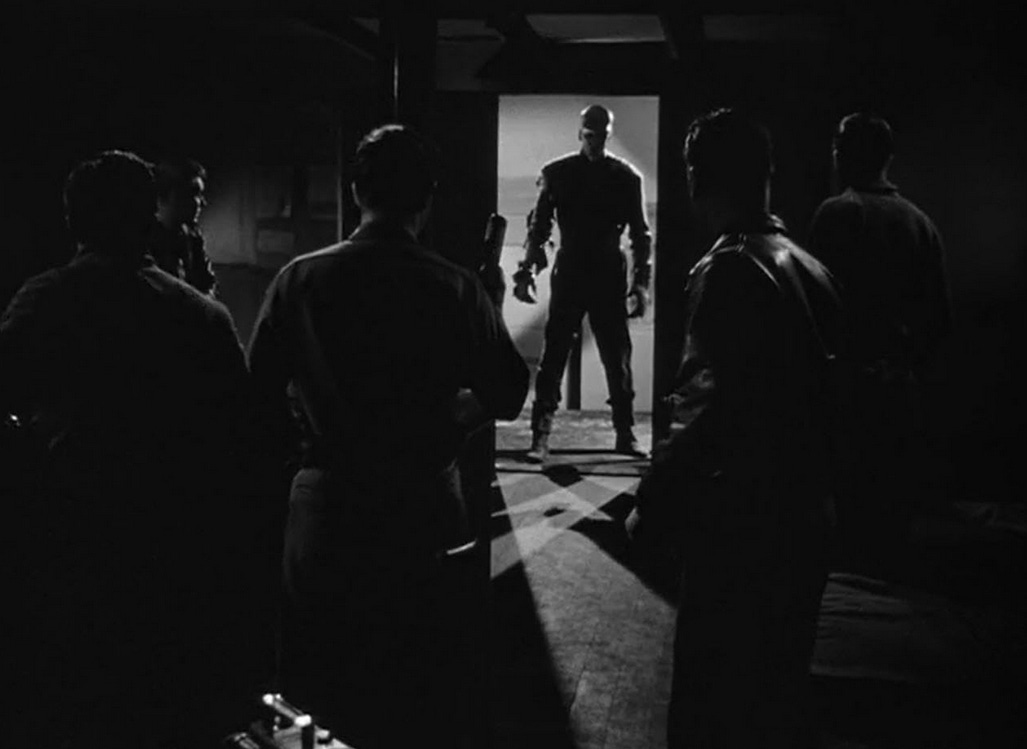
The romance between Hendry and Nicholson (Tobey and Sheridan respectively) isn’t needed at all, but it’s an American B-movie in the 1950s: you’ve got to have a girl to be flirted over and make the odd sarcastic remark in a team of men. She does come up with some good ideas as the film goes on, but the rest of the time she’s a secretary reduced to pouring coffee. The ending of ‘“Watch the skies, everywhere!”’ is, whilst iconic, incredibly cheesy, addressed almost directly to the viewer. The characterisation of The Thing is also fairly sloppy, for all the good work the film does the rest of the time to build it up. With seeing the characters playing chess when arriving at the base, and the opening scene with several characters playing poker, one would think this game-playing element would transfer over, as Mac’s chess game against the computer translates to his battle of wits against The Thing in John Carpenter’s film. Yet despite it being intelligent enough to cut off the heating and electricity to the research base, it also decides simply to bust down doors whilst everyone is looking at it, advance slowly and clumsily, and, when on screen, just act as a big, dumb, stompy guy. Despite apparently being ‘“…a lot smarter than we give it credit for,”’ much like Ghostface in Scream, it is a ninja until seen; when it then it becomes the clumsiest thing in the universe.
All in all, this doesn’t stop the film from being a fun time with some good performances and a nice build-up. It suffers from still being stuck in B-movie mentality, but science-fiction and horror have yet to be given serious A-movie treatment, and at least for audiences today, nobody is expecting cinematic perfection. If you want a good 90 minutes with a bucket of popcorn on a chilly evening, simply put on The Thing from Another World and remember to watch the screens, everywhere.
Score: 7.5/10
Watch and Listen to Second Cut on YouTube
Follow Us @secondcutpod
Follow the Author @kjudgemental
Our Old Work at The Film Magazine
Enjoyed the review Kieran. One of my favourite films and very influential. I think Howard Hawks is all over it.