

Bring Them Down (2024)
Director: Christopher Andrews
Screenwriter: Christopher Andrews
Starring: Christopher Abbott, Barry Keoghan, Nora-Jane Noone, Colm Meany, Paul Ready, Aaron Heffernan, Susan Lynch
by Sam Sewell-Peterson
Some men will go to war over sheep rather than going to therapy.
We’ve seen a glut of gritty farming dramas over the past decade, from Hope Dickson Leach’s The Levelling to Clio Barnard’s Dark River and the French film Bloody Milk from Hubert Charuel, not to mention plenty of countryside takes on the traditionally city-set crime film, such as John Michael McDonagh’s The Guard and Nick Rowland’s Calm with Horses. Christopher Andrews’ directorial debut Bring Them Down finds itself very much part of both Northern European filmmaking trends.
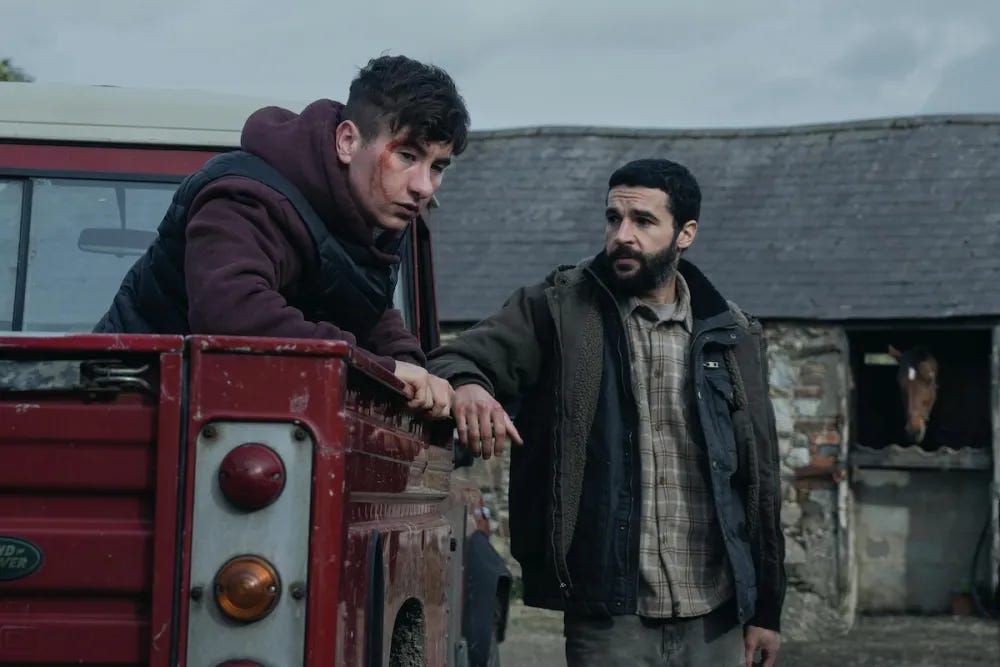
Two neighbouring sheep farming families clash in rural Ireland when the flock of Michael and Ray O’Shea (Christopher Abbott and Colm Meany) are rustled by associates of Jack and Gary Keeley (Barry Keoghan and Paul Ready). Before long bad blood resurfaces and the quartet of men are driven to increasingly desperate behaviour to protect their livelihoods.
The opening scene of a car journey winding through verdant Irish countryside quickly gives way to a relationship breaking down before our eyes with disastrous consequences. It won’t become clear for a while what this sequence is setting up or who the passengers are, but it does set the whole film up on a tonal and thematic level.
Much like the Fast & Furious franchise, this is really all about family, more specifically dysfunctional father/son relationships. The most tender moment Michael and his physically impaired dad Ray share is his brushing off concern over the alarming shade of the full bottle of urine he hands to his son (“You need to drink more water / Water’s for washing in”). Jack and Gary on the other hand manage to work together fairly harmoniously but their relationship at home is more strained, including an inability to show any sort of physical affection until a frustrated fist fight turns into an awkward, restraining bear hug from the older man.
Abbott and Keoghan really are two of the most interesting actors of their generation, both equally versed at conveying repressed trauma and always being on the verge of an emotional outburst. Interestingly, their characters were almost portrayed by two other fascinating performers who have come to prominence in the last decade, Paul Mescal and Tom Burke, at an earlier stage of the project’s development. Abbott’s Michael is a man of few words, but he says so much with his eyes, and what he does say is in one of the few convincing Irish accents from a Hollywood actor, not to mention a few exchanges in Irish Gaelic with the mesmerising Meany. Keoghan has played many working-class roles like this before, but his performance stands out because of his chemistry with Ready and Nora-Jane Noone as Caroline, his affectionate mother (and former girlfriend of Michael, who bears the emotional and physical scars of that relationship).
“There’s livestock and there’s deadstock”. That turn of phrase uttered by Jack at one point proves particularly true as the animal body count rises through the film. There’s a particularly heartbreaking scene that sees Michael have to put several of his animals out of their misery in quick succession after he finds them bleeding to death in a field in the dead of night. They may be his livelihood, but he clearly forms a connection with them over time as well. Later in the film we are harrowingly shown what occurred just before Michael’s arrival.
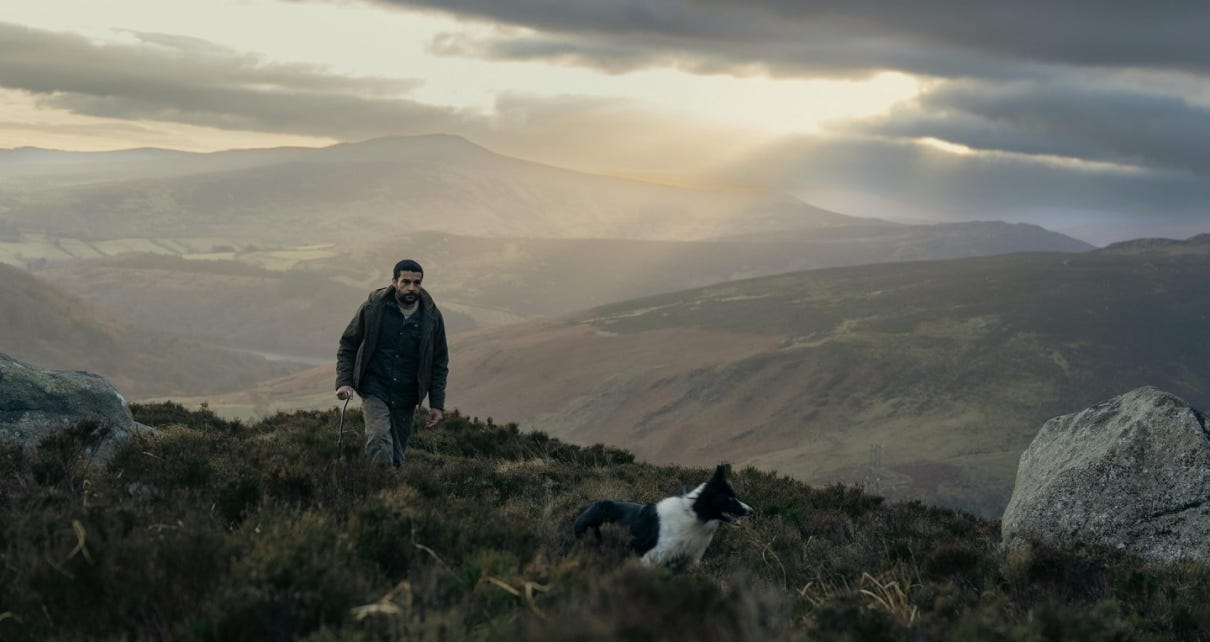
Some of the bleak-beautiful landscapes in this, with shafts of light penetrating grey skies over rolling hills, look like Turner paintings. This is will undoubtedly prove to be one of the most gruelling watches of the year, but cinematographer Nick Cooke makes it all, even the darker side of humanity’s relationship with nature, look stunning.
There has been a fair amount of discussion of gentrification in cities in media in recent years, but perhaps more of a conversation needs to be had about a similar undertaking in rural areas, particularly with so many farmers struggling to make ends meet. We’ll always need farmers to feed our growing populations, but they are often taken for granted by governments and the people who eat the fruits of their labour. Ray dismissively asks Gary “Is that what they call… diversifying?” when the latter asks for access to the road on his property to facilitate the holiday home business he is due to start up on his farmland. It’s the traditional farming lifestyle and business hanging by a thread here as the world changes around it, so it’s little wonder these men lose their senses as they try and survive.
A lot of these films have the structure and iconography of a classic Western. The scenery and accents might be different, but they’re all stories about times changing and protecting me and mine from all-comers. The need for revenge also begins to consume Michael as events escalate, prompting him to take things into his own hands in his quest for justice, with a head-torch, sheepdog and shotgun instead of a stetson, horse and Winchester rifle.
It’s debatable how much is actually gained on a narrative level with some scenes playing out of sequence and much of the second half of the film replaying several key events from different characters’ points of view. This isn’t a Rashomon type of flourish calling in question subjective reality since it’s never in doubt who did what, when, or why, but the more upsetting things depicted in this section could have quite easily been inferred without explicit depiction on camera.
It’s mostly doom-and-gloom, but there is also a vein of extremely dark gallows humour running through much of the film, particularly a moment involving a plastic bag containing something gruesome being handled by multiple people who are blissfully unaware of its contents.
Bring Them Down isn’t one for those who like neat and tidy resolutions or genre thrills. One of the key players bows out of the story without much ceremony, and though our lead does eventually brandish a firearm to defend his territory like a latter-day Old West hero, he is also continually frustrated in actually putting it to good use. Christopher Andrews’ film is a measured and fascinating character study of emotionally repressed men failing to communicate and, ultimately, failing in every other facet of their lives as well because of their need to settle a score.
Score: 8/10
Watch and Listen to Second Cut on YouTube
Follow Us @secondcutpod
Follow the Author @sspthinksfilm
Our Old Work at The Film Magazine
I hadn't heard of this film before reading this review (my own fault for being disconnected from what's going on at the moment), but this review made me want to search it out. Thank you for that and the great insight.